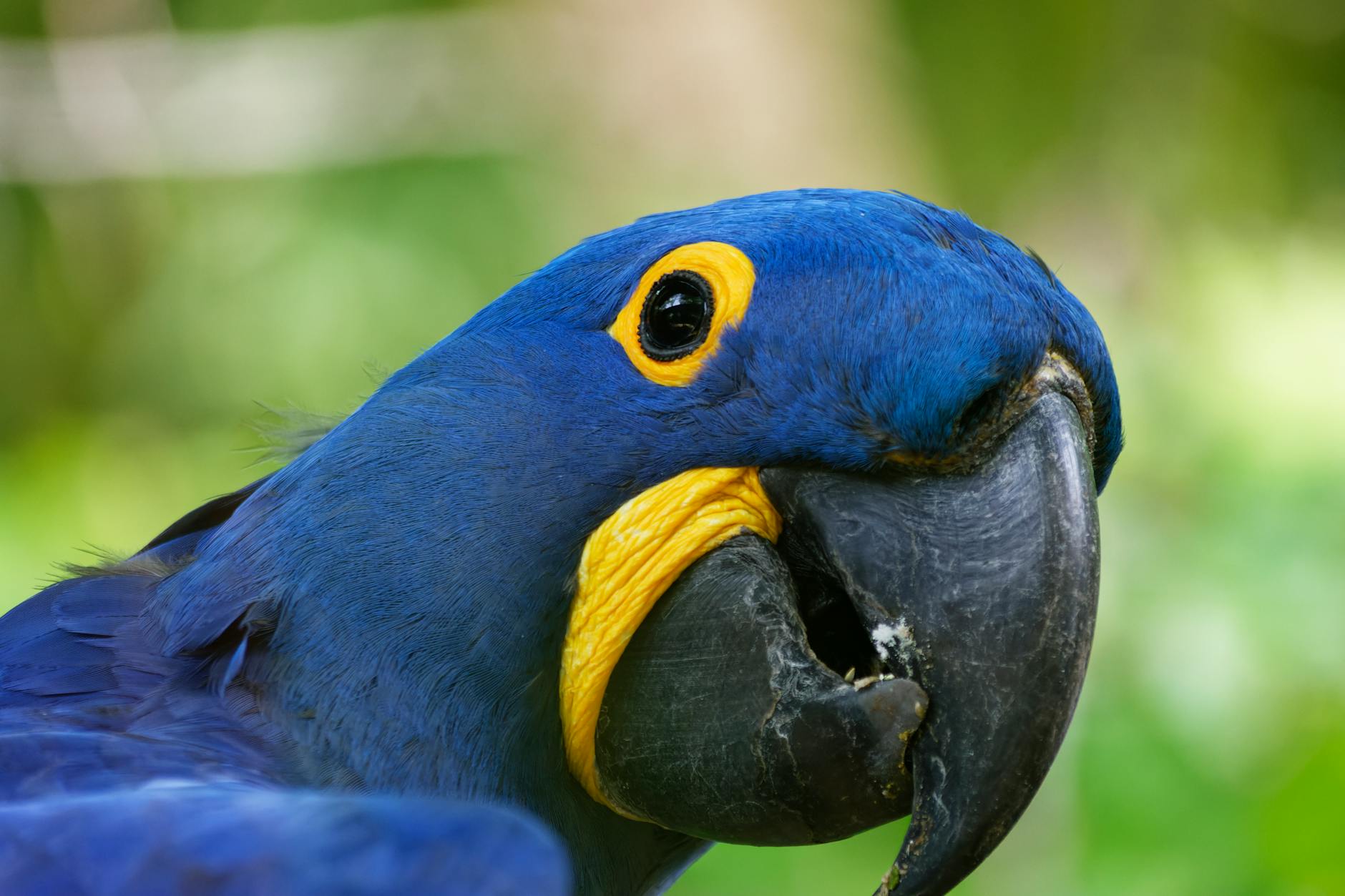
A flash of green cuts through the dappled light of the rainforest canopy, followed by a sharp, unmistakable call that echoes across the treetops. It belongs to no ordinary bird. With a stocky build, a short rounded tail, and plumage that shifts from emerald to lime depending on the angle of the sun, the Amazon parrot is one of the most recognizable and intelligent birds in the tropical Americas.
These parrots are not a single species but an entire genus, Amazona, comprising about 30 distinct species spread from the Caribbean islands south through Mexico and deep into the Amazon basin. They have captivated people for centuries with their mimicry, their social intelligence, and their vivid presence in the forests they call home.
What Is an Amazon Parrot?

Amazon parrots are medium-sized, predominantly green parrots in the family Psittacidae, the true parrots. Their genus Amazona, established by the French naturalist Rene Primevere Lesson in 1830, has since become one of the most studied parrot lineages in the Americas.
Most species share a common body plan: a compact frame, a short squared-off tail, and a powerful hooked beak designed for cracking seeds and nuts. Their green plumage serves as natural camouflage against the leaves of the forest, but almost every species carries a signature accent of color somewhere on the body: a splash of red on the forehead, a streak of yellow on the crown, a flash of blue on the wing, or a patch of lilac behind the neck.
The range of the genus is remarkably broad. Amazon parrots are found from northern Mexico through Central America, across the Caribbean islands, and throughout much of South America. In the Amazon basin alone, multiple species coexist, each occupying a slightly different niche within the forest structure. The mealy amazon (Amazona farinosa), one of the largest species, favors lowland rainforest, while the festive amazon (Amazona festiva) sticks closer to seasonally flooded forests along rivers. This distribution means that protecting Amazon parrot habitat is not about saving a single patch of forest. It is about safeguarding the connected mosaic of tropical ecosystems that sustain the entire genus.
Life in the Tropical Forest
Amazon parrots are built for a life in the trees. Their zygodactyl feet, two toes pointing forward and two backward, give them an extraordinary grip on branches and allow them to manipulate food with surprising dexterity. A parrot holding a piece of fruit in one foot while eating it is a common sight, and this behavior reflects the complex motor control that makes the genus so adaptable.
Their diet centers on seeds, nuts, and fruits, with leafy matter serving as a supplement. In the wild, they forage in flocks, moving through the canopy in small family groups or larger aggregations of dozens of birds. This social structure is central to their identity. Amazon parrots form strong pair bonds, and many species mate for life. Their vocal repertoire is vast: contact calls keep the flock together in dense foliage, alarm calls warn of predators, and softer murmurs between paired birds reinforce social bonds.
What has made Amazon parrots famous beyond the forest is their capacity for vocal mimicry. Many species can learn to reproduce human speech and environmental sounds with striking clarity. This ability, which in the wild likely helps individuals identify flock members and coordinate movement, has made them highly sought after as companion animals. It is also one of the main reasons they are in trouble.
Threats and Conservation Status
The very qualities that make Amazon parrots remarkable, their intelligence, their beauty, and their voices, have placed them under intense pressure from the pet trade. For decades, wild parrots were captured in large numbers and exported to markets in North America, Europe, and Asia. The United States and the European Union have since banned the import of wild-caught parrots, and captive breeding now supplies much of the legal trade. But illegal trapping persists in many parts of Latin America and the Caribbean, and the removal of breeding adults from the wild continues to weaken populations that are already stressed by habitat loss.
The conservation picture for the genus is mixed but increasingly concerning. Of the 36 Amazon parrot species assessed by the IUCN, five are classified as endangered and four as critically endangered. Some, like the imperial amazon (Amazona imperialis) of Dominica, have been pushed to the brink by a combination of habitat destruction and severe weather events. Others, like the red-crowned amazon, have declined steadily across their range in northeastern Mexico and southern Texas.
Habitat loss compounds every other threat. As tropical forests are cleared for agriculture, ranching, and infrastructure, the nesting cavities and foraging grounds that Amazon parrots depend on disappear. These birds need mature trees with natural hollows for breeding, and when those trees are removed, breeding success plummets even in areas where the birds are otherwise protected from capture.
The problem is especially acute in Brazil and Peru, where road construction and agricultural expansion continue to fragment the forest. A parrot pair that loses its nesting tree may not breed at all that season, and if the surrounding canopy has been thinned, the remaining trees may not offer enough cover from hawks and other predators. Feral populations of Amazon parrots now exist in places as far-flung as southern Africa, Europe, and several US cities, a testament to their adaptability but also a reminder that their wild populations are under pressure that captive escapees do not face.

Amazon parrots nest in tree hollows, making mature forest essential for breeding. Attribution to be filled after image selection.
Why Protecting Their Habitat Matters
Every Amazon parrot is a thread in a larger ecological fabric. As seed dispersers, they help regenerate the forest they live in. When a parrot eats a fruit and later deposits the undigested seed elsewhere, it participates in one of the oldest and most important partnerships in tropical ecology. The trees feed the birds, and the birds plant the trees. Break that cycle, and the forest thins in ways that cascade through every layer of the ecosystem.

Amazon parrots travel long distances through the canopy, dispersing seeds across the forest. Attribution to be filled after image selection.
Protecting Amazon parrots means protecting the forests that sustain them, and that is a challenge that reaches far beyond any single species. The Amazon basin holds an estimated 1,500 bird species, and the health of parrot populations often mirrors the health of the broader avian community. Where parrots thrive, the forest is usually intact enough to support toucans, macaws, eagles, and the countless smaller birds that keep insect populations in check and pollinate flowering plants.
The connection between the brilliant green parrot in the canopy and the forest floor beneath it is not metaphorical. It is physical, nutritional, and reproductive. Save the tree hollow, and you save a generation of parrots. Save the forest, and you save the tree hollows.
The good news is that Amazon parrots respond quickly when their habitat is protected. In reserves and national parks across their range, parrot numbers stabilize and often begin to climb within years of effective protection. This is what makes direct rainforest conservation so powerful as a strategy. When land is secured and patrolled, the parrots stay, the trees stand, and the cycle of seed and fruit continues uninterrupted. The Amazon parrot does not need a rescue mission. It just needs its forest left standing.