
Walk into the Daintree and you feel the age before you understand it.
The light comes through in broken shafts. The canopy is so layered and dense that the air beneath it has its own temperature, its own humidity, its own quiet logic. Ferns that look like they belong in another era grow along creek banks as though they always have. Leaves the size of dinner plates catch the filtered light. Somewhere above you, a cassowary moves through undergrowth too thick to see through.
What you’re standing inside is the world’s oldest surviving tropical rainforest. The Daintree, in the Wet Tropics of northeastern Queensland, has been here for approximately 180 million years. To put that number in some kind of scale: when this forest first took root, the dinosaurs hadn’t yet reached their peak. The southern supercontinent Gondwana was still intact. The Atlantic Ocean didn’t exist. The landmasses we now call Africa, South America, Antarctica, and Australia were still pressed together in a single mass.
The Daintree predates all of that. It was ancient before Australia was Australia.
So How Old Is the Daintree, Really?
The 180-million-year figure refers to the continuous lineage of plant families now present in the Wet Tropics — not a single stand of trees standing unchanged since the Jurassic. Forests don’t work that way. Individual trees live and die, canopies shift, species move over time. What persists across geological time is the lineage: the evolutionary thread connecting today’s species to their deep ancestors.
The Daintree contains plant families documented in this region since the Cretaceous period, over 100 million years ago. Some of the flowering plant families found here are among the most primitive known examples of their kind anywhere on Earth — lineages that branched off from the rest of the world’s flora before the continents separated and have been evolving in the isolation of northeastern Australia ever since.

Scientists sometimes describe the Daintree as a living museum. That framing is understandable but it undersells the place. A museum is static. The Daintree has been actively evolving, generating new species, and responding to its environment for longer than most of Earth’s current geography has existed.
The Wet Tropics World Heritage Area, which encompasses the Daintree and the surrounding connected rainforest, covers 8,944 square kilometres. The Daintree lowland section itself — the part north of the Daintree River that most visitors experience — covers around 1,200 square kilometres. Within that relatively small area sits a concentration of wildlife and plant life that is genuinely difficult to compare with anywhere else.
What Actually Lives Here
The numbers UNESCO uses to justify the Daintree’s World Heritage status are striking, but they only make sense when you think about the geography. The Wet Tropics covers less than 0.2% of Australia’s land area. Within that fraction lives roughly 30% of the country’s frog species, 65% of its butterfly species, and around 40% of its bird species. More than a third of Australia’s mammal species live here, many of them found nowhere else in the country.
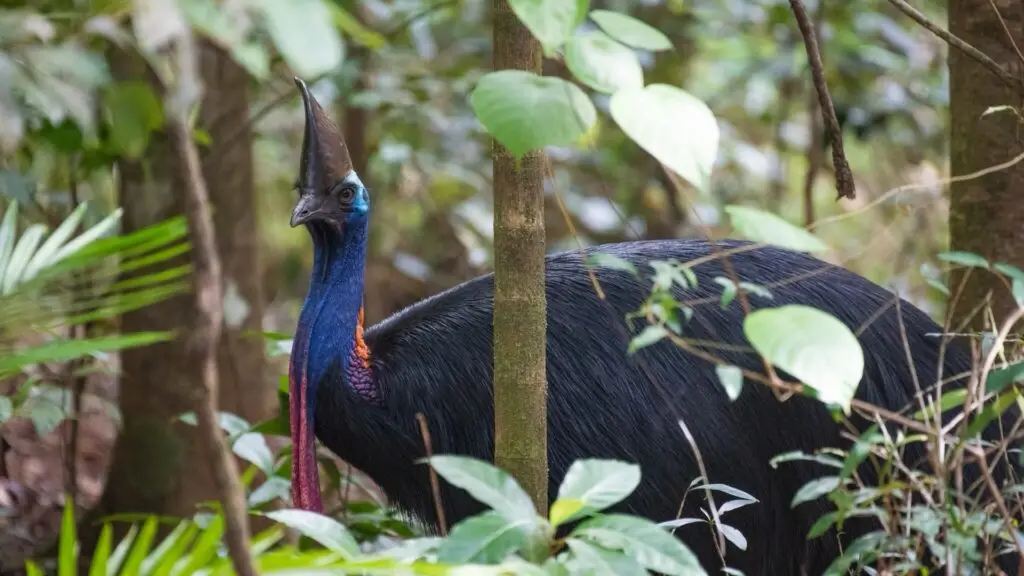
The cassowary is the most visible symbol of all this. This prehistoric-looking flightless bird, which can reach 1.8 metres tall and weigh up to 60 kilograms, exists in Australia almost entirely within the Wet Tropics. It plays a role no other animal in the forest can replicate: it eats large fruits whole and deposits the seeds — sometimes kilometres away — intact and ready to germinate. Over 100 plant species depend on the cassowary for seed dispersal. Remove the bird and you don’t just lose the bird; you begin to lose the forest’s ability to regenerate itself.
That kind of deep ecological interdependence is what 180 million years of uninterrupted forest life produces. Relationships between species so layered and specific that pulling on one thread affects dozens of others. It’s the kind of complexity that a reforestation project, however well-intentioned, cannot recreate in any human timeframe.
How It Survived the Ice Ages
Surviving 180 million years means outlasting a remarkable list of catastrophes. Mass extinctions. The breakup of Gondwana. Sea level swings of over 100 metres. And a series of ice ages that repeatedly transformed ecosystems across the planet. The most recent of those, the Last Glacial Maximum around 20,000 years ago, is the one we understand best — and the way the Daintree came through it explains a lot about why it remains so important today.
When global temperatures dropped by around 5 to 6 degrees Celsius, most of Australia’s rainforest contracted dramatically. The vegetation that replaced it across much of the continent was dry woodland and grassland. But the Wet Tropics had a geographic advantage that most other rainforests didn’t: the peaks of the Great Dividing Range in northeastern Queensland act as a barrier to moisture-laden air moving in from the Coral Sea. Even during the driest periods of the ice age, those mountains kept intercepting enough atmospheric moisture to keep parts of the rainforest viable.

Researchers have identified three specific pockets within the Wet Tropics where forest conditions remained stable throughout the Last Glacial Maximum — one in the north, one central, one further south. Between these refugia, the forest thinned or disappeared temporarily. Within them, the full complexity of tropical rainforest life continued uninterrupted.
The species inside those pockets had nowhere to go. The creatures of the Daintree were geographically cornered, surrounded by drier landscapes with no corridor to a similar climate anywhere nearby. So they adapted in place. They specialised. And over thousands of years of enforced isolation, many of them became something found nowhere else on Earth. The pattern of species diversity you see in the Daintree today still reflects the shape of those ice age refugia. Richness is highest where the sheltered zones were. It tells you something about a forest when its current biology still carries the imprint of a climate event that ended 12,000 years ago.
Read more: Which Rainforests Survived the Last Ice Age — And What Happened After
50,000 Years of Human Presence
The Daintree isn’t just ancient in geological terms. The Kuku Yalanji people have lived in and around this forest for an estimated 50,000 years, making their connection to the landscape one of the longest continuous relationships between people and a specific environment anywhere on Earth.
That relationship shaped the forest in ways we’re only beginning to understand properly. Fire management, selective use of plants, deep knowledge of seasonal patterns and animal behaviour — this wasn’t passive co-existence. The Kuku Yalanji were active participants in the forest’s ecology across tens of thousands of years. The biodiversity we value so highly in the Daintree today is partly a product of that stewardship, built alongside 180 million years of evolutionary history rather than separate from it.
It’s a dimension worth holding onto when we think about what conservation actually means in a place like this. The Daintree’s resilience was never just a function of geography. It was also a function of people who understood it deeply and looked after it accordingly.
Quick fire facts on the daintree!
Quick Facts: Daintree Rainforest
For anyone researching the Daintree, here are the key figures:
Age: Approximately 180 million years — the world’s oldest surviving tropical lowland rainforest.
Size: Around 1,200 km² for the Daintree lowland section. The broader Wet Tropics World Heritage Area covers 8,944 km².
Location: Northeastern Queensland, Australia, north of Cairns between the Daintree River and Cooktown.
Wildlife: Home to roughly 30% of Australia’s frog species, 65% of butterfly species, 40% of bird species, and over a third of its mammal species — in less than 0.2% of the country’s land area.
World Heritage Status: Listed by UNESCO in 1988, recognised for its outstanding universal value as a living record of the evolutionary history of land plants.
Indigenous connection: Home to the Kuku Yalanji people for approximately 50,000 years.
Conservation status: The core is protected under World Heritage listing, but private lowland areas outside the boundary remain under pressure from development and climate change.
What It’s Up Against Now
The World Heritage listing in 1988 was a genuine turning point. Before it, the Daintree was being logged and cleared at rates that would have eliminated significant portions of the lowland rainforest within a generation. The listing slowed that dramatically within the protected zone.
But a boundary on a map doesn’t address everything.
Climate change is already altering the Wet Tropics in measurable ways. The rainfall patterns that kept the Daintree’s refugia viable through the last ice age operate within a specific climatic envelope — and that envelope is shifting. Warmer temperatures, changed cyclone patterns in the Coral Sea, and reduced dry season rainfall are all affecting the forest’s composition in ways that weren’t expected to show up for decades. They’re showing up now.
Outside the protected zone, Queensland’s statewide land clearing continues at scale, driven largely by agriculture. That clearing, while not happening inside the Daintree itself, chips away at the ecological corridors that connect the Wet Tropics to surrounding habitats. A forest that survived ice ages by maintaining connected refugia doesn’t do well when the landscape around it becomes fragmented. Isolation is what turned the ice age refugia into evolutionary laboratories — that same isolation, imposed by cleared land rather than climate, becomes a trap rather than a shelter.
Some private landholdings in the Daintree lowland area outside World Heritage protection continue to face development pressure. Acquiring that land permanently and removing it from the development equation is one of the most direct conservation actions available — extending the protection that 1988 began, piece by piece.
Why the Age Matters Beyond the Number
There’s a practical reason to care about how old the Daintree is, beyond the wonder of the figure itself. Age in a forest ecosystem is a proxy for accumulated ecological complexity — the layered, specific, hard-won relationships between species that develop over millions of years of living alongside each other. The fungi connecting tree root systems. The insects that pollinate specific flowers. The birds that distribute specific seeds to specific places. The soil biology that processes nutrients in ways science has barely begun to map. These don’t spring up in a restored forest or a plantation. They develop across timescales that dwarf human history.

When conservation scientists describe old-growth primary forests as being worth many times more for biodiversity than new plantations, this is the substance behind that claim. It’s not about sentiment. It’s about the depth of ecological relationship that only time produces, and that cannot be fast-tracked regardless of how much money or effort goes in.
The oldest tropical rainforest on Earth is also one of the most tested. It has survived conditions that ended most other ecosystems. That track record of resilience has real scientific value: the Daintree shows us what genuine long-term stability looks like, and what life does with enough time and space to operate without interruption. Protecting it, then, isn’t preservation for its own sake. It’s maintaining a living system that has already proven, across 180 million years, that it knows how to endure.
Read more: Rainforest Refugia: What They Are and Why They Kept Life Alive
Frequently Asked Questions
What is the oldest rainforest in the world? The Daintree Rainforest in northeastern Queensland, Australia. Its plant lineages trace back approximately 180 million years, making it the oldest surviving tropical rainforest on Earth.
How old is the Daintree Rainforest? Around 180 million years old, based on the documented age of plant family lineages present in the Wet Tropics bioregion. For context, the Amazon rainforest formed in its current configuration roughly 55 million years ago.
Is the Daintree older than the Amazon? Yes, by a significant margin. The Amazon is extraordinarily biodiverse but formed in its current shape around 55 million years ago. The Daintree’s plant lineages go back approximately 180 million years.
How big is the Daintree Rainforest? The Daintree lowland section covers approximately 1,200 square kilometres. The broader Wet Tropics World Heritage Area, which includes connected rainforest habitats across northeastern Queensland, covers 8,944 square kilometres.
Why is the Daintree Rainforest important? The Daintree holds the world’s oldest surviving tropical plant lineages, an extraordinary concentration of endemic species found nowhere else, and a 180-million-year track record of surviving climate catastrophes that destroyed ecosystems everywhere else. Its ecological complexity took longer to build than almost any other living system on Earth.
Is the Daintree Rainforest protected? The core is protected as part of the Wet Tropics World Heritage Area since 1988. Some areas of lowland rainforest outside the formal boundary remain on private land and face ongoing development pressure.

 EN
EN  DE
DE