
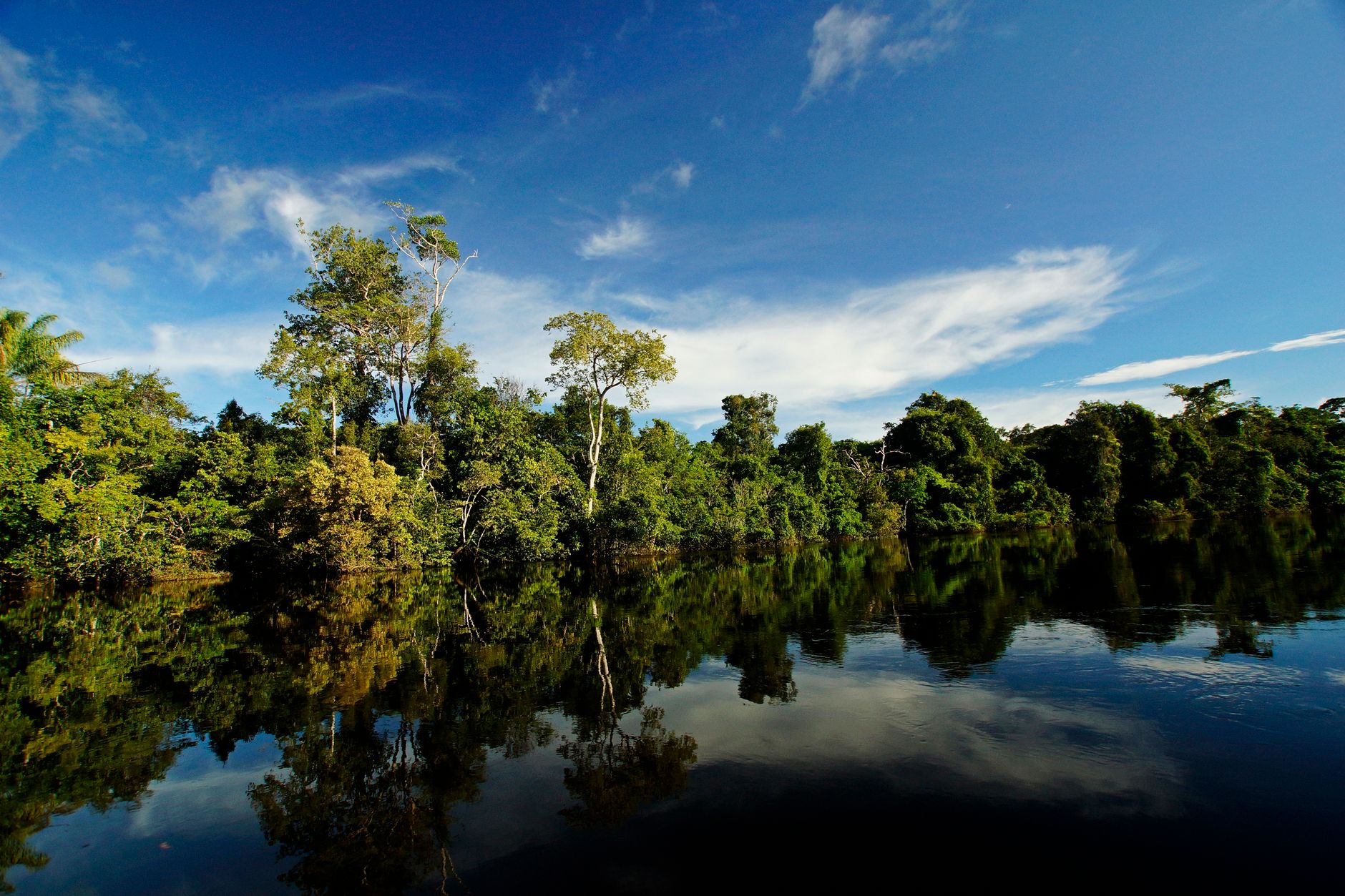
Featured image: River and forest in the Brazilian Amazon. Illustrative photograph; atmospheric moisture pathways are not visible. Photo: Miguel Cuenca / Pexels. Source.
MAAP Report 250, published on 16 October 2026, estimates cumulative forest-cover loss equivalent to 15% of the Amazon biome’s original primary forest by the end of 2025. The estimate includes fire damage that may represent forest degradation rather than permanent clearing. The report also maps where forest loss overlaps the seasonal paths of “flying rivers”, the airborne moisture flows that forests help replenish as winds carry water inland from the Atlantic.
The report does not offer a single countdown to one inevitable Amazon tipping point. Instead, it shows why place matters. Moisture follows different routes in wet, dry and transition seasons, and forest loss along some pathways can affect rainfall conditions farther downwind.
That makes protecting standing forest a climate issue as well as a biodiversity issue. Trees return water to the atmosphere, helping sustain rainfall farther inland between the Atlantic and the Andes.
What MAAP’s 2026 analysis found
The MAAP report combines an estimate of original Amazon forest with historical loss data updated through 2025. It uses the RAISG 2020 biogeographical boundary, covering eight countries and French Guiana. This Amazon biome boundary extends beyond the river’s watershed.
The authors estimate that original Amazon primary forest covered 647.6 million hectares before European colonisation. They then estimate total historical loss at 97.06 million hectares by the end of 2025, which they calculate as 15% of that original forest. The report says this combined loss includes both fire-related and non-fire loss, and can also include natural causes such as landslides and windstorms.
The figure is not a net balance of forest change. MAAP states that its estimate does not include forest gain or regeneration. It is also not interchangeable with Brazil’s annual PRODES deforestation estimate, which has another time frame, territorial boundary and purpose. One number describes cumulative primary-forest loss across the multinational Amazon biome; the other tracks annual suppression of native vegetation in Brazil’s Amazon Legal region.
The update includes an estimated 13.04 million hectares of loss from 2022 to 2025, a period that included the fire-heavy year of 2024. MAAP separates post-2000 loss using University of Maryland datasets for forest loss and loss due to fire, then combines the categories to remain consistent with its historical estimate.
How flying rivers connect forest and rainfall
Winds carry moisture from the Atlantic across the Amazon toward the Andes. Rain falls on the forest, then evaporation and water released by trees replenish the air’s moisture. MAAP describes this recycling in its flying-rivers overview. Forest helps sustain that recycling, so changes to forest cover can alter the atmosphere as well as the ground beneath it.
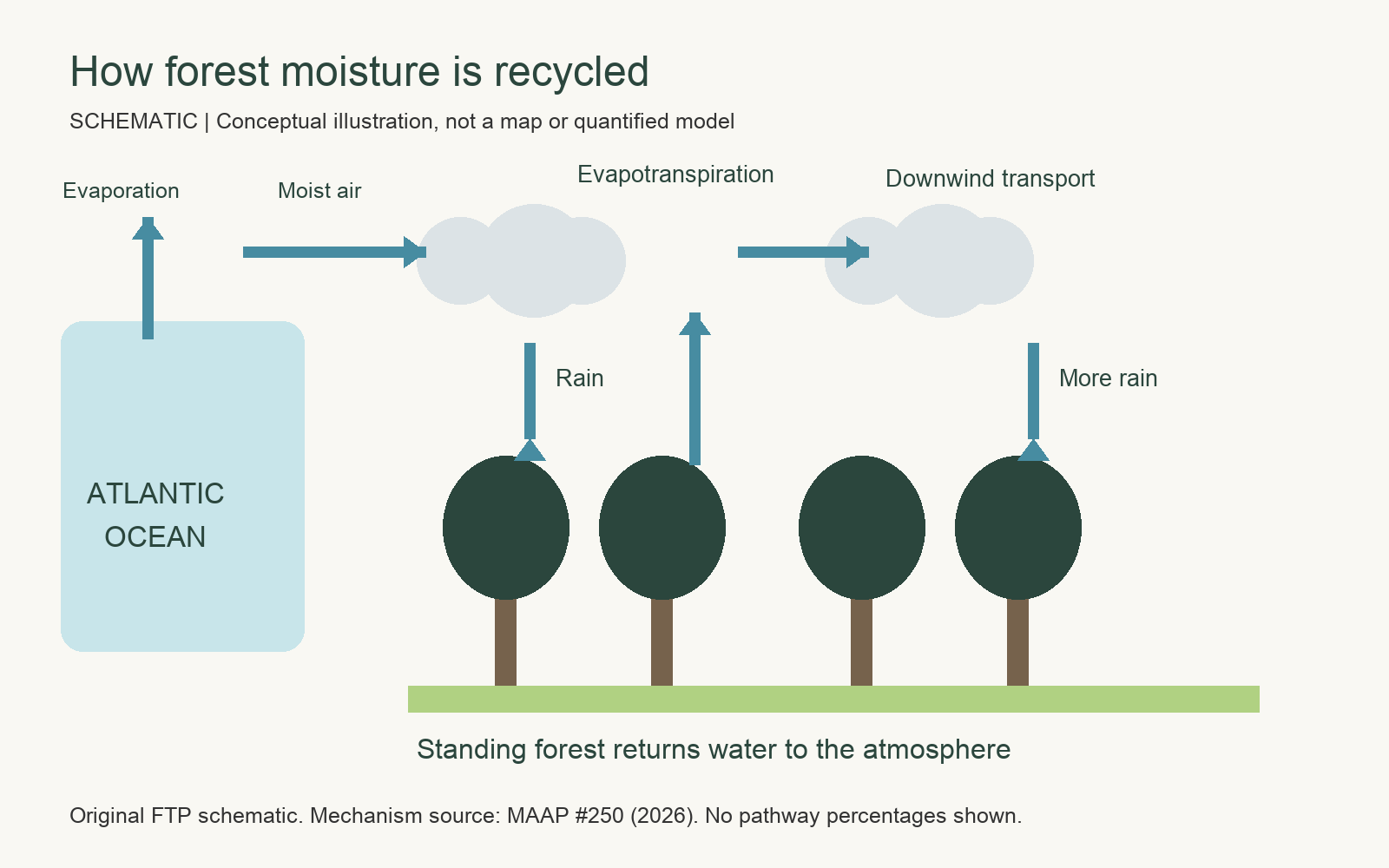
The mapped pathways supplying sensitive forests in the southwestern Amazon shift with the seasons. The wet-season route crosses more northerly forests, while the dry-season route passes farther south. The transition-season route lies between them. These routes cross different areas of forest loss, so the forests downwind face different risks throughout the year.
That seasonal difference helps explain the concern about deforestation in the eastern and central Amazon. Loss there can reduce moisture moving westward, with potential consequences for downwind forests that rely on rainfall during water-stressed periods. The report presents this as a vulnerability shaped by geography and season, rather than a uniform switch that flips across the whole rainforest at once.
This is one reason the phrase “tipping point” should be used carefully. The report discusses threshold research in conjunction with climate change, but it does not establish one universal predictive threshold for the whole biome. It also says some areas may be affected sooner and harder than others.
Why dry-season pathways deserve attention
MAAP maps a higher proportion of forest loss along the dry- and transition-season pathways to the southwestern Amazon than along the wet-season pathway. The authors say this matters because forest-driven moisture recycling is especially important for maintaining rainforests in the southwest Amazon when water is scarce.
MAAP defined original forest using mapped classes for forest, non-forest and water, then made adjustments using satellite images and official data from several Amazonian countries. For post-2000 years, it used University of Maryland forest-change data and classified loss with medium to high fire certainty as fire-related.
MAAP calls its post-2000 result the best estimate or proxy for primary forest loss, and explains that non-fire loss can be more permanent while fire loss may be closer to degradation. Combining both supports a consistent historical comparison, but it also means the 15% result should not be reduced to a pure measure of permanent clearing.
Protecting standing forest is part of the climate response
Keeping forest standing protects wildlife habitat and helps maintain the recycling of water. That is a reason to conserve forests alongside cutting greenhouse gas emissions, not a substitute for those cuts.
Forest protection has effects beyond the edge of a reserve. The same trees that provide wildlife habitat also return water to the air, helping sustain the forests downwind.
Protection also needs to be grounded in the particular forest at risk. The report does not say that every part of the Amazon faces the same trajectory, and neither should conservation communication. Local territories, seasonal pathways, monitoring methods and the causes of forest loss all affect what good decisions look like.
Protecting standing forest and restoring cleared land can both support moisture recycling. Standing forest is already returning water to the air; restoration can help recover that function where forest has been lost.
MAAP’s 15% estimate is not a prediction that the Amazon has already crossed a single irreversible line. It is a mapped estimate showing that cumulative forest-cover loss overlaps seasonal moisture pathways, especially the dry and transition routes. The analysis does not directly measure how much rainfall or moisture transport has changed because of that loss.
For forests in the southwestern Amazon, protection matters along the routes that supply their rain, including routes that cross national borders. Conserving those forests helps maintain the moisture recycling on which downwind ecosystems depend. Start protecting rainforest with Fund the Planet.


 EN
 DE