
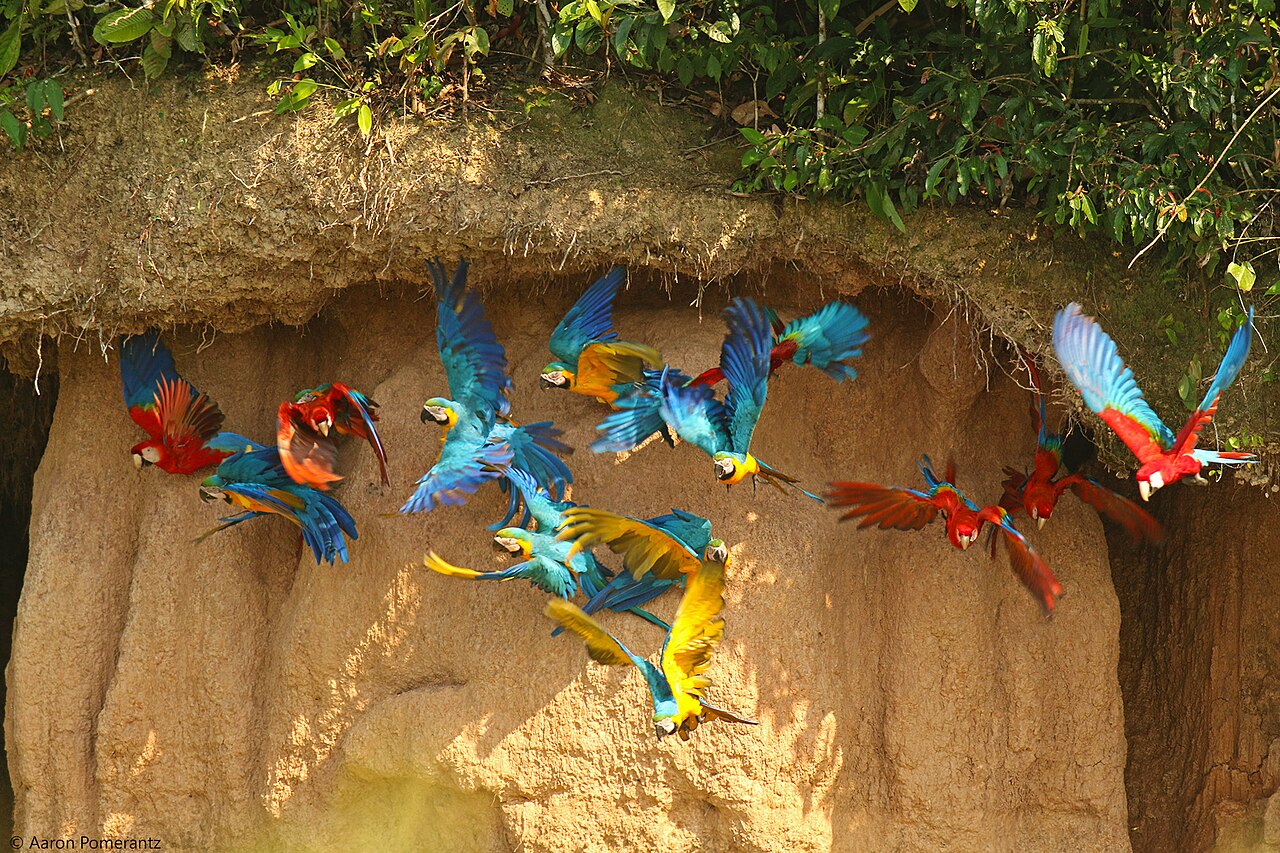
At first light in Tambopata, the forest gets loud before it gets bright. Scarlet macaws cross the river in red, yellow, and blue flashes, then settle on exposed clay banks with dozens of other parrots. The scene looks theatrical, but the behavior is practical.
Clay licks, also called colpas in parts of Peru, are places where birds and mammals eat mineral-rich soil. For scarlet macaws, these sites are more than beautiful photo opportunities. They are part of a daily relationship between rainforest animals, riverbanks, geology, and nutrition.
What clay licks are
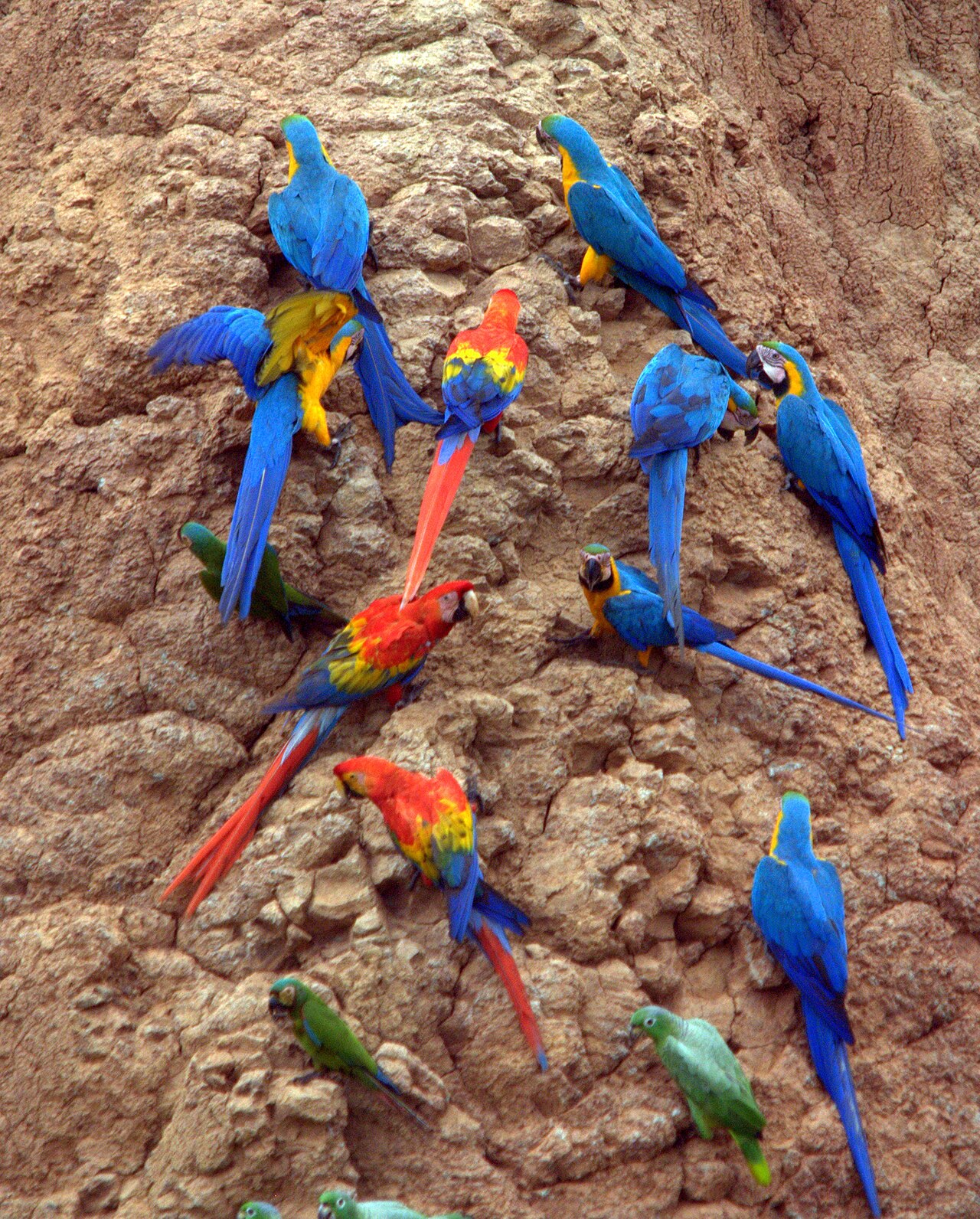
A clay lick is an exposed patch of soil where animals gather to consume clay or mineral-rich earth. In the western Amazon, many of the most famous licks sit along riverbanks, where erosion exposes layers of soil that animals can reach. Macaws, parrots, parakeets, tapirs, deer, and other animals may use these sites.
Research from the Tambopata Macaw Project and related studies has shown that sodium is a major part of the story. Many rainforest fruits and seeds are low in sodium, while some clay lick soils contain much higher sodium levels. That helps explain why parrots may travel to these places repeatedly, especially in forests where salt is scarce.
The older explanation was simple: parrots ate clay to neutralize plant toxins. That may still play a role in some contexts, but the sodium hypothesis is now one of the strongest explanations for many Amazon parrot clay licks. Good conservation writing should keep both ideas clear rather than pretending the science is settled in one sentence.
Why scarlet macaws return each morning
Scarlet macaws are large, social parrots with powerful bills and long lives. They eat fruits, seeds, nuts, and other plant material, and their feeding choices connect them to the health of the forest around them. Clay licks add another layer to that relationship by offering minerals that may be difficult to find elsewhere.
The morning timing is not accidental. Birds often gather early, when temperatures are lower and movement along the river is easier. Large gatherings also create social information. A macaw arriving at a clay lick can see where other birds are feeding, assess danger, and join a familiar rhythm that many birds repeat day after day.
Clay licks are also risky. A noisy gathering of bright birds can attract predators, and the open riverbank offers less cover than the canopy. That tension makes the behavior even more striking. The birds keep coming because the site offers something valuable enough to justify the exposure.
Tambopata and the value of protected rainforest
Tambopata in southeastern Peru is one of the best-known places in the world to observe macaw clay licks. The region’s rivers, forests, and mineral banks create the conditions for large parrot gatherings. It is also a reminder that spectacular wildlife moments depend on ordinary habitat features that can be damaged by deforestation, mining, road building, and disturbance.
Scarlet macaws are not only colorful symbols of the rainforest. They are part of a larger community of seed-eating, fruit-eating, and canopy-traveling animals. Their presence points to forests with mature trees, nesting cavities, feeding routes, and safe movement across the landscape.
Fund The Planet has written more broadly about rainforest biodiversity hotspots and the Peruvian Amazon as habitat for endangered species. Clay licks make that biodiversity visible. They compress a whole forest into one riverbank, where geology and animal behavior meet every morning.
What a clay lick teaches us
A clay lick is easy to admire and easy to misunderstand. The spectacle is the flock, but the lesson is the system. Macaws need safe nesting trees, feeding habitat, river corridors, mineral banks, and enough intact forest around them for the behavior to continue.
That is why protecting rainforest is not only about saving green space on a map. It is about keeping relationships intact. A clay lick without forest becomes a stage without actors. A forest without safe riverbanks loses one of its quiet nutritional pathways.
When scarlet macaws gather at a Peruvian clay lick, they are not performing for us. They are following a rainforest logic older than the trail, the camera, and the lodge platform. The best thing we can do is protect enough of that logic for the morning flights to keep returning.


 EN
EN  DE
DE