Somewhere in the understory of an Amazon rainforest, a palm tree is said to be walking. Not quickly. Not visibly. But over years, the story goes, it pulls up roots, tilts toward the light, and inches across the forest floor. The walking palm tree, Socratea exorrhiza, has been the subject of this claim for decades. Scientists have spent nearly as much time investigating whether it is true, and what they found is more interesting than the myth.
What the Walking Palm Actually Is
The walking palm tree is real, and it is native to tropical rainforests in Central and South America. It grows to about 15 to 25 meters tall, with a slender trunk and a crown of large, fan-shaped leaves. Its most striking feature is the set of stilt roots that emerge from the trunk a meter or more above the ground, arching outward and down like the legs of a tripod, sometimes forming a cone of roots that can spread several meters wide.
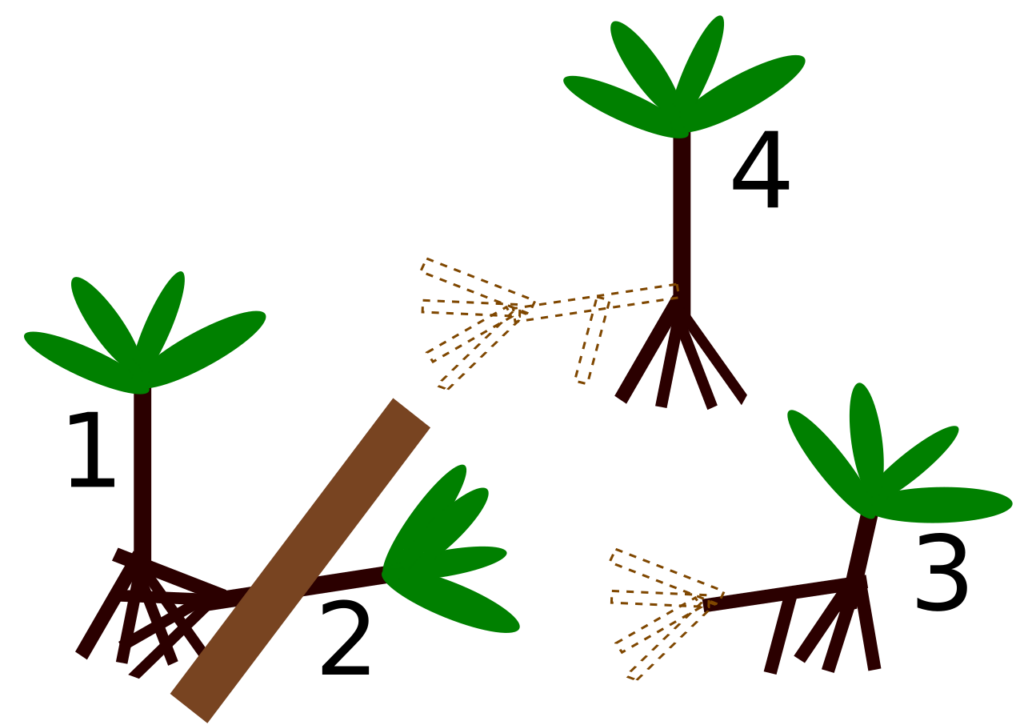
Those roots gave rise to the walking claim. Rainforest guides, popular science writers, and nature documentaries have long repeated the idea that the palm can grow new roots on one side while letting old roots die off on the other, slowly shifting its position toward better light across the forest floor. The image is compelling: a tree that solves the problem of shade by simply leaving.
The problem is that controlled studies have not found evidence that the tree actually moves. In 2005, biologist Gerardo Avalos and his team published a study in the journal Biotropica that tested the walking hypothesis directly. They measured root growth and die-off patterns in multiple individuals over several years. Their conclusion was clear: while roots on one side can die while new ones grow on another, the trunk itself does not shift position. New roots grow to replace old ones, not to relocate the tree.
Why the Stilt Roots Exist
If the roots do not help the tree walk, what are they for? The leading hypothesis, supported by the same Biotropica research, is stability. Socratea exorrhiza tends to grow in swampy, flood-prone soils where a conventional root system would struggle to anchor a tall palm securely. Stilt roots distribute weight across a wider base and keep the trunk elevated above seasonal floodwaters that can persist for weeks.
The roots may also allow the palm to establish itself quickly. In a competitive rainforest understory, where light gaps open and close unpredictably as larger trees fall, being able to put down a functional root system without investing years in a deep taproot gives the species a reproductive edge. The stilt roots allow rapid height gain without sacrificing stability, a trade-off that works well in the unpredictable architecture of a mature forest.

There is also evidence that the palm can regenerate if the main trunk is damaged, sprouting new growth from the root crown. In a forest where falling branches and treefalls are routine events, this kind of resilience is not a luxury. It is a necessity.
What the Walking Palm Teaches Us About Rainforest Resilience
The walking palm is not a tree that walks. It is a tree that solved a hard engineering problem with an elegant structure. In the saturated, unstable soils of the Amazon floodplain, a conventional root system would fail. Stilt roots work, and they work well enough that the species thrives across the entire northern half of South America.

This kind of adaptation is everywhere in the rainforest once you look for it. The iconic plants of the Amazon each represent a different evolutionary answer to the same fundamental challenges: competition for light, nutrient-poor soil, and seasonal flooding.
Even a single square meter of rainforest floor contains dozens of plant species coexisting through different survival strategies, each one a working solution to problems that have shaped life in this ecosystem for millions of years.
Auch diversity of rainforest plants is not decorative. It is the product of relentless selective pressure, and every species that survives represents a strategy that works. The walking palm myth endures because it is a good story. But the truth is arguably better: the rainforest is full of genuine marvels that do not need embellishment. A tree that engineered its own structural scaffold to survive seasonal floods is remarkable enough on its own.
The deeper point is that each of these adaptations, whether the stilt roots of a walking palm or the buttressed trunk of a kapok tree, took millions of years to evolve and can be erased in an afternoon by a chainsaw. The Amazon’s plant diversity exists because the forest has remained intact long enough for natural selection to produce an encyclopedia of survival strategies. Protecting what remains of that forest means protecting not just the species we have named but the evolutionary processes that continue to produce new ones. Socratea exorrhiza will not walk away from a cleared field. The only thing that can protect it is keeping the forest standing.