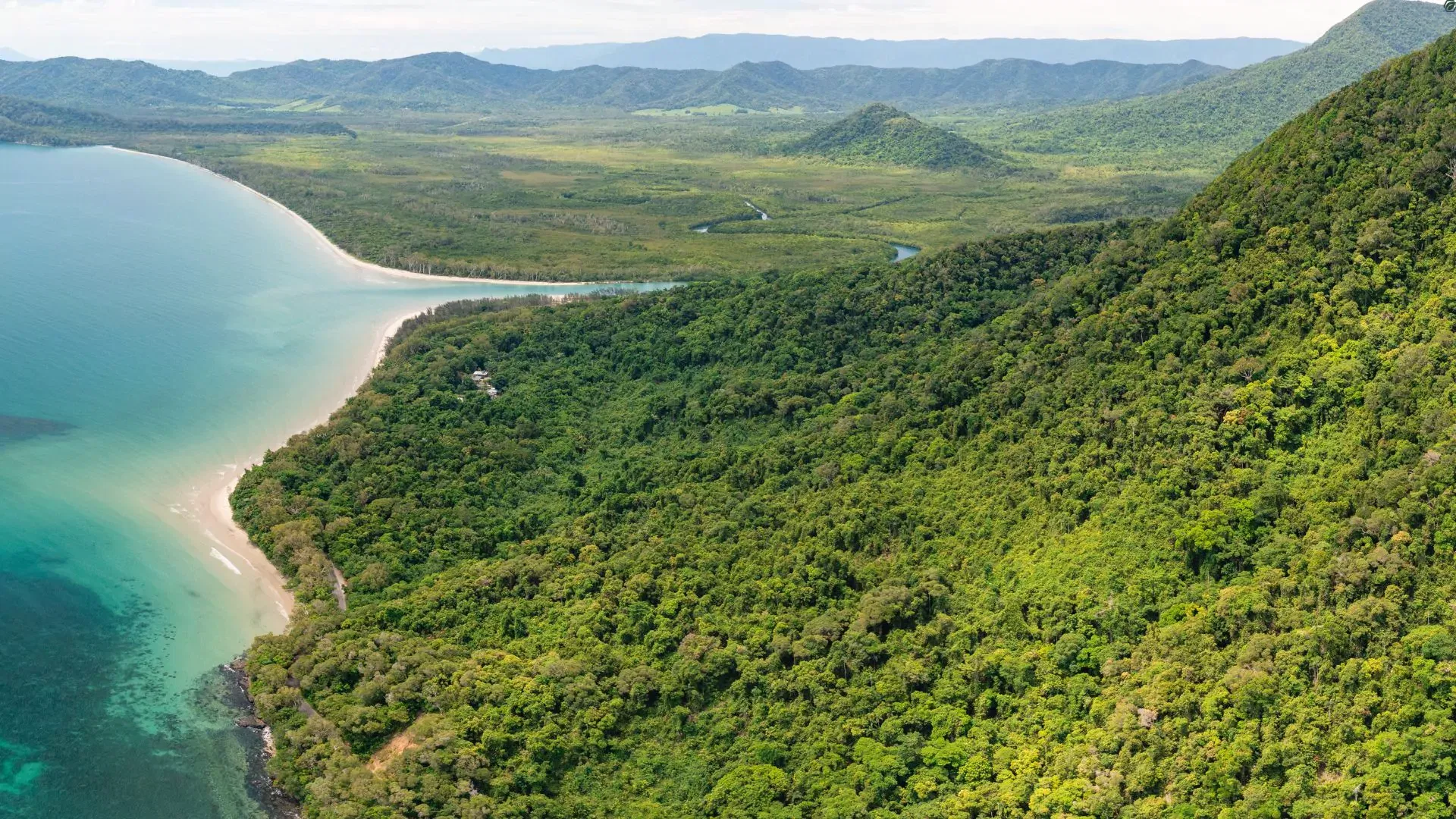

From the air, the pattern is unmistakable. Vast grids of uniform green oil palm plantations stretching to the horizon, interrupted by the occasional brown scar of a new clearing, the orange-red of exposed earth still raw from the machines. And then, sometimes, a remaining patch of something different. Darker. Denser. Irregular. A fragment of what Borneo used to look like across its entire surface.
Borneo was once one of the most intact rainforest islands on Earth. Today, estimates put the loss of its original primary forest at around 92%. Let that number sit for a moment. Not 20%. Not half. Nine-tenths of the primary forest that covered this island for over 130 million years, gone within the span of a few human generations with most of it within living memory.
In 2024 alone, Indonesia which governs the Kalimantan portion of Borneo cleared around 264,000 hectares of forest, an area larger than Luxembourg, in a single year. Malaysia’s portion of the island, covering the states of Sabah and Sarawak, tells a similar story. The deforestation of Borneo is one of the fastest large-scale ecosystem losses in recorded history, and it’s still happening.
Understanding what’s actually being lost not just in terms of trees, but in terms of what those forests represent scientifically and ecologically changes how you see the urgency of stopping it.
This Isn’t Just a Forest. It’s a 130-Million-Year Archive.
Most conversations about Borneo deforestation frame it as a habitat loss problem. It is. But it’s also something more specific and harder to convey: the destruction of one of the oldest continuously existing ecosystems on the planet.
The rainforests of Borneo and Sumatra — part of the ancient landmass scientists call Sundaland — have been growing in this part of the world for over 130 million years. They predate the separation of the continents into their current configuration. They were ancient when the dinosaurs disappeared. The plant families present in Borneo today trace their lineages back to the Cretaceous period, and they have been evolving in this specific location, in this specific ecosystem, continuously since then.
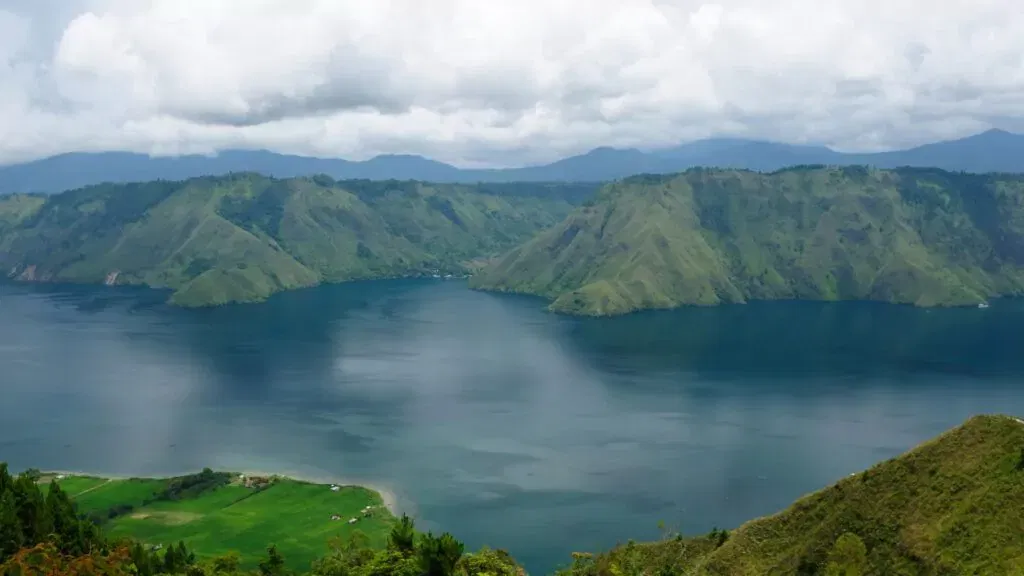
What that continuity produces is a depth of ecological relationship that simply cannot be replicated. Every species in a 130-million-year-old forest has co-evolved with dozens of others across timescales that make human history look trivial. The fungi that connect root systems between trees. The specific insects that pollinate specific flowers. The fig trees and the fig wasps that have evolved in lockstep for so long that neither can reproduce without the other. Pull enough of these threads and the system stops working — not gradually, but at a threshold that, once crossed, is effectively irreversible.
Scientists studying old-growth forest ecology consistently find that primary forests like Borneo’s store significantly more carbon, support far greater species diversity, and provide more hydrological stability than any secondary or plantation forest. The gap isn’t small. A patch of oil palm where Borneo rainforest used to stand is, ecologically speaking, a near-complete erasure.
What Borneo Did During the Ice Ages
Here’s the part of Borneo’s story that most deforestation coverage misses entirely — and it’s the part that makes the loss most consequential.
During the last ice age, roughly 20,000 years ago, most of the world’s rainforests fragmented or collapsed as global temperatures dropped and rainfall across the tropics failed. Borneo didn’t. While forests contracted across most of Southeast Asia, the upland forests of northern Borneo held on. The island’s equatorial position insulated it from the worst temperature extremes, and its mountainous terrain intercepted enough atmospheric moisture to keep the forest intact when surrounding regions dried out.
What researchers found when they started modelling which species were where during the glacial maximum genuinely surprised them. Rather than fragmenting into isolated pockets — which is what happened almost everywhere else — the Sundaland forests actually expanded during the ice age, marching across continental shelf exposed by 120 metres of sea level drop to occupy new territory. Borneo wasn’t just surviving. It was growing.
Research published in the Proceedings of the National Academy of Sciences tracking 317 dipterocarp species — the towering trees that form the backbone of Southeast Asian rainforests — confirmed this pattern across the glacial record. Central Sundaland maintained continuous, extensive forest cover while surrounding regions contracted. Northern Borneo, specifically, was the stable core around which the rest of the region’s biodiversity was anchored.
That matters because of what happened next. When the ice retreated and sea levels rose again, populations that had expanded across the exposed shelf got isolated in specific refugia as the water returned. The genetic diversity generated during that expansion then dispersed outward as climates stabilised, seeding the biodiversity of the broader Indo-Pacific region. Borneo was the engine. The rest of Southeast Asia’s rainforest biodiversity was, in significant part, the output.
Destroy that engine and you don’t just lose what’s there now. You lose the source from which the surrounding region has repeatedly rebuilt itself across geological time.
Read more: Which Rainforests Survived the Last Ice Age — And What Happened After
What’s Actually Driving the Clearing
Borneo’s deforestation isn’t a mystery. The drivers are well documented and largely economic, which makes them tractable — and makes the failure to address them a choice rather than an inevitability.
Palm oil is the dominant force. Indonesia and Malaysia together produce around 85% of the world’s palm oil, and Borneo sits at the centre of that production. Palm oil is in roughly half of all packaged products sold in supermarkets globally — from biscuits and chocolate to shampoo and lipstick. The economics of converting forest to palm oil plantation are straightforward: clear the timber (which has its own value), sell the carbon credits from what’s left (a system now under intense scrutiny for its integrity), and plant a crop with a 25-year productive life and guaranteed global demand.
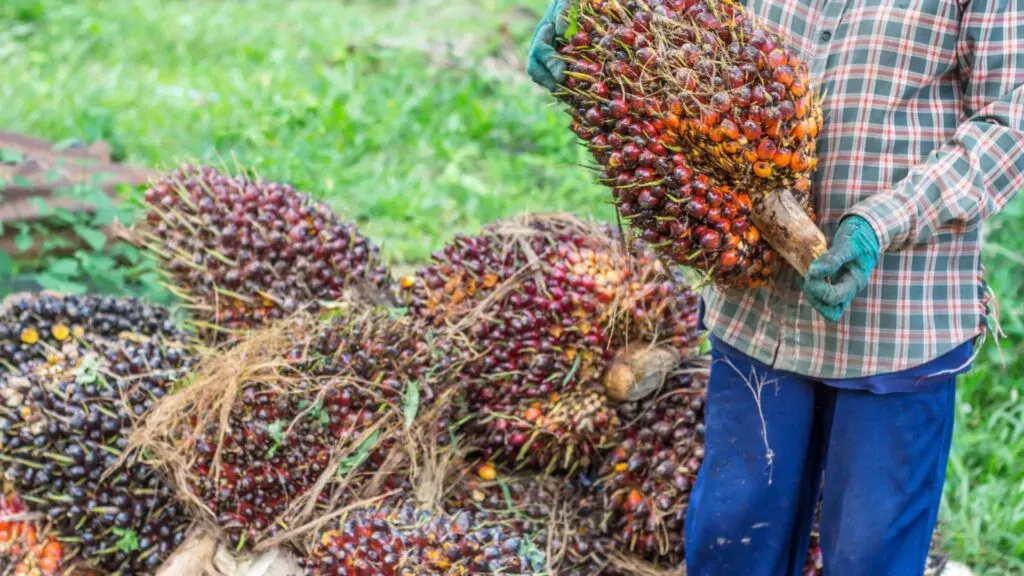
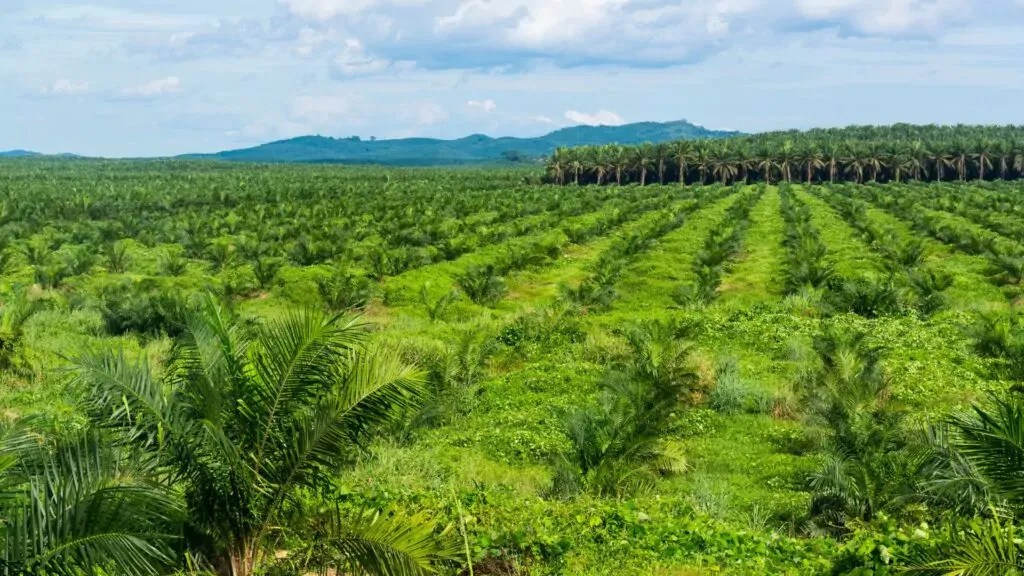
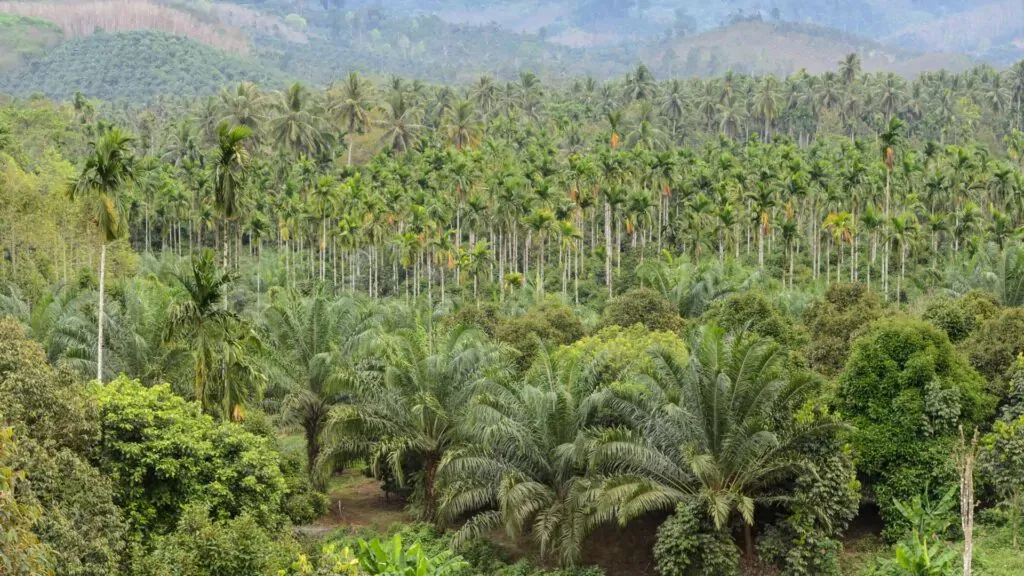
Pulpwood and paper production account for much of the rest, particularly in the lowland peat forests of Kalimantan and Sumatra, which are among the most carbon-dense ecosystems on Earth. When peat forests burn — as they do regularly during clearing operations, sometimes intentionally, sometimes not — they release carbon that has been accumulating for thousands of years in a matter of days. The 2015 Indonesian peat fires, driven largely by land clearing for palm oil, released more carbon in a few weeks than Germany produces in an entire year.
Mining adds a third layer, particularly in Borneo’s interior, where coal, gold, and bauxite deposits have drawn industrial extraction operations into areas previously too remote to clear economically. Infrastructure follows mining — roads, settlements, supply chains — and each new road into primary forest opens the surrounding land to further clearing.
What ties all of these drivers together is that they’re responding to global demand. The deforestation of Borneo is not primarily a local problem with local causes. It’s the on-the-ground consequence of consumption patterns distributed across the entire world.
The Species That Can’t Afford to Lose More Ground
Borneo hosts more than 6% of all known species on Earth, in an island that covers less than 1% of global land area. That concentration is a direct product of the 130-million-year continuity described above — time and stability, producing specificity and depth.
The Bornean orangutan is the most familiar symbol of what’s at stake. Listed as critically endangered by the IUCN, the species has lost over half its population in the past 60 years, almost entirely due to habitat loss. Orangutans are slow breeders — a female produces one offspring roughly every seven to eight years — which means their populations can’t recover quickly even when habitat pressure eases. The trajectory, without significant intervention, points toward functional extinction within this century.
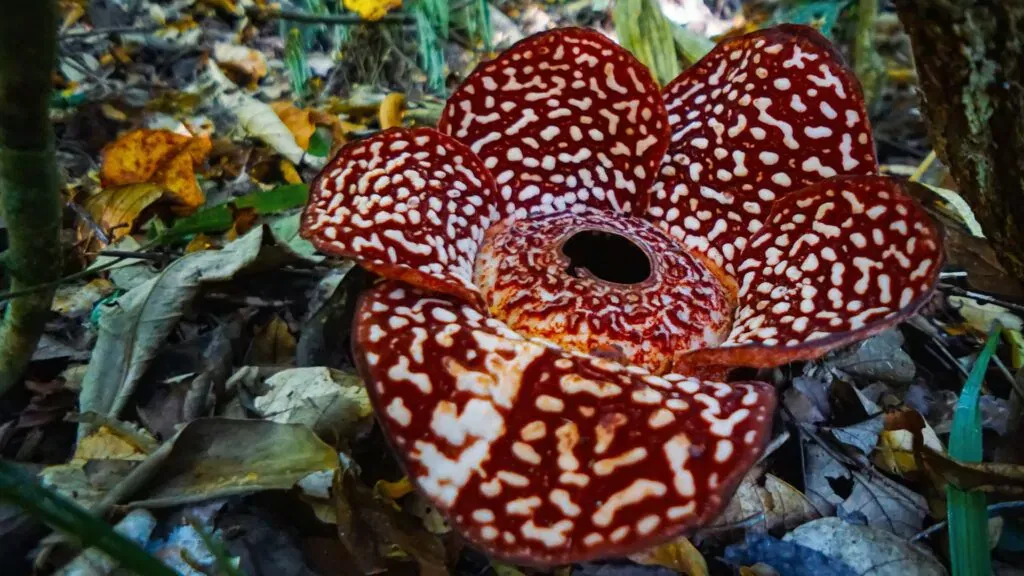
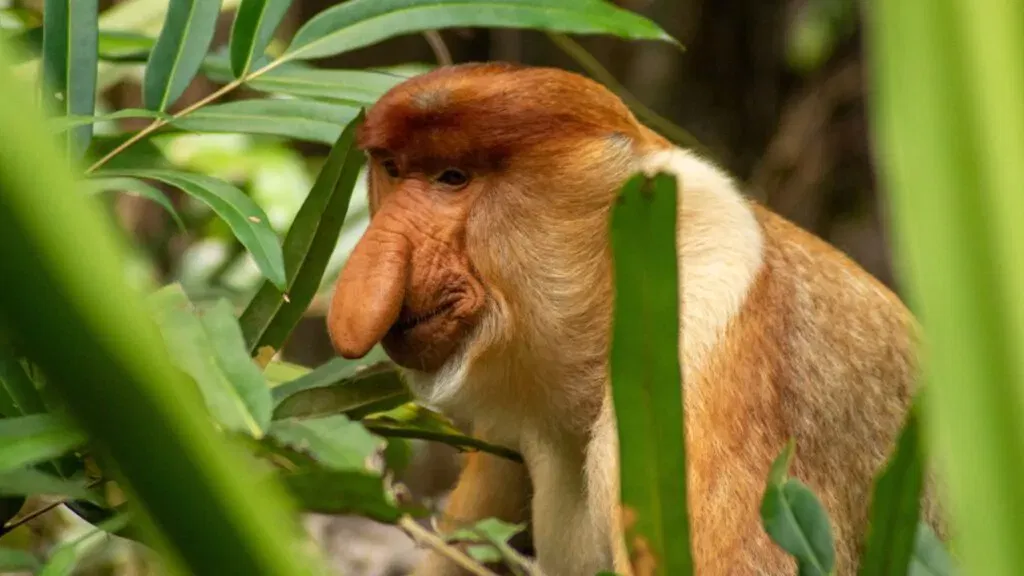
The Bornean clouded leopard, the pygmy elephant of Sabah, the proboscis monkey with its extraordinary riverside behaviour — each of these species has evolved specifically within the Borneo ecosystem, over timescales that shaped their biology, their behaviour, and their dependence on specific forest structures. They’re not generalists that can adapt to disturbed habitat. They’re specialists that co-evolved with primary forest over millions of years, and they have nowhere else to go.
Below the charismatic megafauna, the losses are harder to track but ecologically just as significant. Borneo’s dipterocarp forests — the towering hardwoods that create the multi-storey canopy structure of Southeast Asian rainforest — are among the most commercially targeted timber species in the world. Their slow growth and specific reproductive requirements mean that selectively logged forest doesn’t recover into the same structural complexity within any human timeframe. What looks like regrown forest from the air often functions, ecologically, as a much simpler and less biodiverse system than what was there before.
The 2024 Numbers in Context
The 264,000 hectares cleared in Indonesia in 2024 needs some context to understand properly.
Global Forest Watch, which tracks deforestation via satellite in near-real time, recorded 2024 as one of the highest deforestation years on record globally, with tropical primary forest loss accelerating sharply. The Indonesian figure reflects clearing concentrated heavily in Kalimantan and Sumatra, driven by a combination of palm oil expansion, pulpwood plantations, and what Indonesian law classifies as legal land clearing for agricultural development.
That last point is worth dwelling on. The majority of recent Borneo deforestation is legal. It proceeds with permits, within frameworks established by national governments, in response to economic pressures and development priorities that are entirely understandable from the perspective of countries managing rapid population growth and global commodity markets. That makes the standard conservation framing — stopping illegal logging, prosecuting bad actors — insufficient on its own. Most of what’s happening to Borneo isn’t illegal. It’s the predictable outcome of an economic system that prices timber and palm oil but doesn’t price 130-million-year-old ecosystems.
The trajectory, if current rates continue, points toward the loss of most remaining primary forest in Borneo’s lowlands within decades. The upland refugia — the northern Borneo highlands that were the stable core through the last ice age — face increasing pressure as lowland clearing pushes operations further into interior terrain.
Why Replanting Can’t Solve This
The standard response to deforestation concerns, offered by commodity companies and governments alike, is replanting. Plant trees elsewhere. Offset the loss. Restore what was cleared.
The problem with this framing, applied to a place like Borneo, is that it treats forest as a renewable resource measured in tree cover rather than an irreplaceable system measured in ecological complexity and time.
A replanted forest in Borneo — or anywhere else — starts accumulating species, relationships, and structural complexity from zero. The fungi networks take decades to develop. The canopy layers take a century to establish. The full complement of species that depend on old-growth structural features — hollow trees, decomposing logs, specific epiphyte communities — take far longer than that to return, if they return at all, given that the seed sources and dispersal species may themselves be gone.
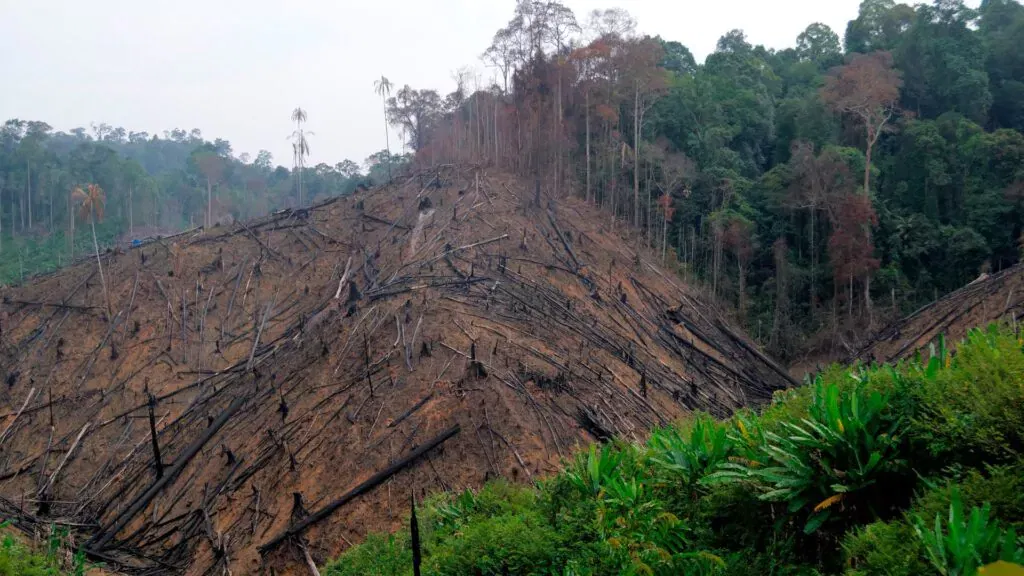
Research comparing primary and secondary forests consistently finds that restored forests recover around 80% of species richness over decades, but that the remaining 20% — the specialists, the endemics, the species with the most specific habitat requirements — may not return within any practical timeframe. In a forest with 130 million years of accumulated specificity, that 20% represents an enormous and irreplaceable portion of what makes it ecologically significant.
Replanting is better than nothing. But it is not a substitute for protecting what exists, and framing it as one allows the destruction of primary forest to continue with a veneer of responsibility attached.
What Can Actually Make a Difference
The scale of Borneo’s deforestation can make the problem feel beyond the reach of any individual response. The honest answer is that it partly is — industrial deforestation at this scale requires policy change, corporate accountability, and consumer pressure across global supply chains simultaneously.
But the other honest answer is that direct land protection still works. The areas of Borneo that remain intact are the areas where clearing hasn’t happened — and where it hasn’t happened, it’s usually because something, or someone, was in the way. Protected areas in Borneo have demonstrably reduced deforestation rates within their boundaries. Indigenous land rights, where legally recognised and enforced, have similarly protected forest at rates that compare favourably with formal conservation designations.
The mathematics of Borneo conservation are, in this sense, straightforward. Every hectare of primary forest that doesn’t get cleared is a hectare of 130-million-year-old ecosystem that keeps functioning. Every corridor maintained between upland refugia and lowland forest keeps the species pump operating. Every piece of land removed from potential development permanently shifts the equation, even if incrementally.
The forests that outlasted the ice ages are under pressure that the ice ages never applied. But they haven’t all gone. The refugia that mattered most through geological time — the northern Borneo uplands and the connected montane forests — are still largely intact. Keeping them that way is, by the measure of what they represent and what they’ve survived, one of the highest-leverage conservation decisions available.
Read more: Rainforest Refugia: What They Are and Why They Kept Life Alive
Häufig gestellte Fragen
How much of Borneo’s rainforest has been destroyed? Estimates place the loss of Borneo’s original primary forest at around 92%, with the majority of that loss occurring since the 1970s. In 2024 alone, Indonesia cleared approximately 264,000 hectares of forest across its Kalimantan and Sumatran territories.
What is causing deforestation in Borneo? The primary drivers are palm oil production, pulpwood and paper plantations, and mining operations, all responding to global demand. Most of the current clearing is legal under Indonesian and Malaysian law, making enforcement-focused conservation responses insufficient on their own.
Why is Borneo deforestation a global problem? Because the demand driving it is global. Palm oil appears in roughly half of all supermarket products worldwide. The carbon released by Borneo’s peat forest fires enters the global atmosphere. And the biodiversity being lost — including species that seeded the broader Indo-Pacific’s ecology across geological time — is a global inheritance, not a local one.
Can Borneo’s rainforest be restored? Partially. Replanted forests recover significant portions of species richness over decades, but the specialists and endemics that evolved specifically in primary old-growth conditions may not return within any practical timeframe. Primary forest protection is ecologically irreplaceable in ways that restoration cannot fully substitute for.
What species are most at risk from Borneo deforestation? The Bornean orangutan is critically endangered with over half its population lost in 60 years. The Bornean clouded leopard, pygmy elephant, and proboscis monkey all face severe habitat pressure. Below the megafauna, hundreds of endemic plant and invertebrate species face functional extinction as their specific habitat requirements disappear.